The search for a new home often begins with a rush of excitement and a series of digital “what-ifs.” You find a house online, enter the price into a mortgage calculator, and see a monthly payment and amortization schedule that fits comfortably within your budget. It feels like a definitive win—a magic number that confirms your dream is within reach.
However, as a financial strategist, I have seen too many buyers fall into the trap of over-reliance on these tools. While mortgage calculators are invaluable for crunching complex formulas, they are helpful but fundamentally incomplete. They provide a ballpark estimate, yet they often omit the “surprises” that can derail a household budget. To move from a casual browser to a sophisticated buyer, you must look behind the math to see what these tools aren’t telling you.
1. The “Principal & Interest” Trap: The Hidden 30%
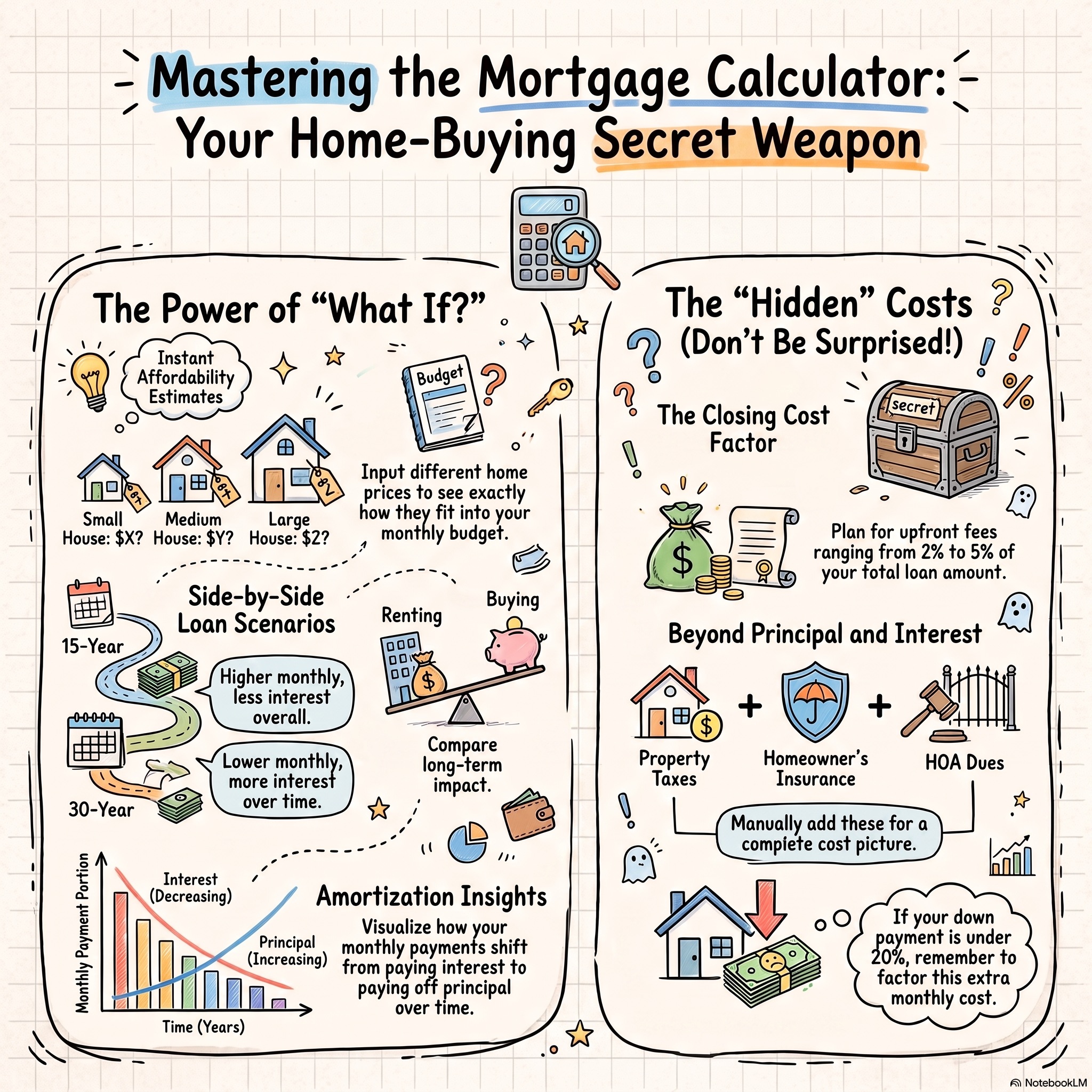
Most basic mortgage calculators focus almost exclusively on “Principal and Interest” (P&I). This is the core of your loan: the principal is the amount you borrowed, and the interest is the fee the lender charges for the service. While P&I makes up the bulk of your payment, it rarely represents your total cost of housing.
According to the Consumer Financial Protection Bureau (CFPB), failing to account for additional monthly costs can lead to significant underestimations. To find your true “total monthly payment,” you must manually add several factors that calculators often omit:
-
- Property Taxes: These vary wildly by location. While for-sale listings provide estimates, they are often outdated. A professional strategist’s tip: Visit the specific county auditor or assessor’s website to find the most accurate tax data for a property.
- Homeowner’s Insurance: A requirement for any mortgage; costs can be estimated by getting a quote from an insurance provider.
- Mortgage Insurance (PMI): Generally required if your down payment is less than 20%.
- HOA or Condo Dues: These are paid separately but are essential to your housing budget.
This distinction is critical for your purchasing power. For instance, a $200,000 condo with luxury amenities and $500 monthly dues can have the same total monthly cost as a $300,000 single-family home with no HOA fees. As the CFPB advises:
“Add those monthly amounts to the principal and interest payment from your mortgage calculator to find out how much you can expect to pay for your total monthly payment.”
2. The “Perfect Credit” Mirage
The interest rates you see pre-filled in online calculators are often a “best-case scenario.” Lenders typically advertise rates that assume a borrower has a nearly flawless credit profile and a 20% down payment. If your financial profile differs, your actual rate—and your monthly budget—will shift.
There are three primary factors that “move the needle” on the interest rate a lender will actually offer you:
-
- Credit Score
- Down Payment Size
- Loan Term
The impact of a slight rate change is larger than most buyers realize. The CFPB provides a stark comparison: a 200,000, 30-year loan at a 4% interest rate results in a P&I payment of **955 per month**. That same loan at a 5% interest rate jumps to $1,074 per month. That $119 monthly difference adds up to tens of thousands of dollars in extra interest costs over the life of the loan.
3. The 5% Closing Cost Shock
A common mistake for first-time buyers is assuming the down payment is the only upfront cash required. In reality, you must prepare for the “cash-to-close” hurdle—a range of fees paid at the end of the transaction to finalize the loan.
Closing costs typically range from 2% to 5% of the loan amount. Failing to calculate these can lead to a liquidity crisis at the finish line. These non-negotiable outlays generally include:
-
- Origination Fees: Charges from the lender for processing, underwriting, and administrative work.
- Appraisal Fees: The cost to have a professional verify the home’s market value for the lender.
- Title Insurance: Protection against legal issues or “clouds” regarding property ownership.
- Prepaid Taxes and Interest: Funds collected upfront to seed an escrow account for property taxes and cover interest accruing between your closing date and first payment.
4. The Power of “How” You Pay: Wealth-Building Simulations
A mortgage calculator’s true value isn’t just as a “bill estimator”—it should be used as a wealth-building simulator. By looking at the “Total Interest Paid” metric, you can see how different loan structures drastically change your net worth over time.
-
- The 15-Year vs. 30-Year Choice: A 15-year mortgage comes with a higher monthly obligation, but because the rate is often lower and the term is shorter, you save a fortune in total interest paid.
- The Bi-Weekly Hack: Some tools allow you to simulate bi-weekly payments. By paying half your mortgage every two weeks, you effectively make 13 full payments a year. This simple shift can shave years off your mortgage and save thousands in interest, turning your home into a debt-free asset much faster.
5. The “Rent vs. Buy” Reality Check
We often hear that buying is always better than renting, but a sophisticated calculator will tell you that the “winner” depends on your intended timeline and local market data.
Calculators that compare renting and buying factor in a renter’s insurance and the long-term equity gain of a mortgage. However, if you only plan to stay in a home for two or three years, the high upfront closing costs and the interest-heavy nature of early mortgage payments might make renting the more stable financial choice. Buying becomes the clear victor only when the “term”—your duration of stay—allows the equity growth to outpace the costs of acquisition and maintenance.
Conclusion: Becoming a Calculated Buyer
Mortgage calculators provide the hypothetical scenarios that serve as the foundation for smart, informed decisions. However, they are a starting point, not a final answer. By accounting for the hidden 30% in monthly fees, using realistic interest rates, and preparing for the 5% closing cost shock, you move from a place of mystery to a place of mastery.
Now that you know the hidden variables, is your “dream home” budget truly ready for the reality of the closing table?